
Aug
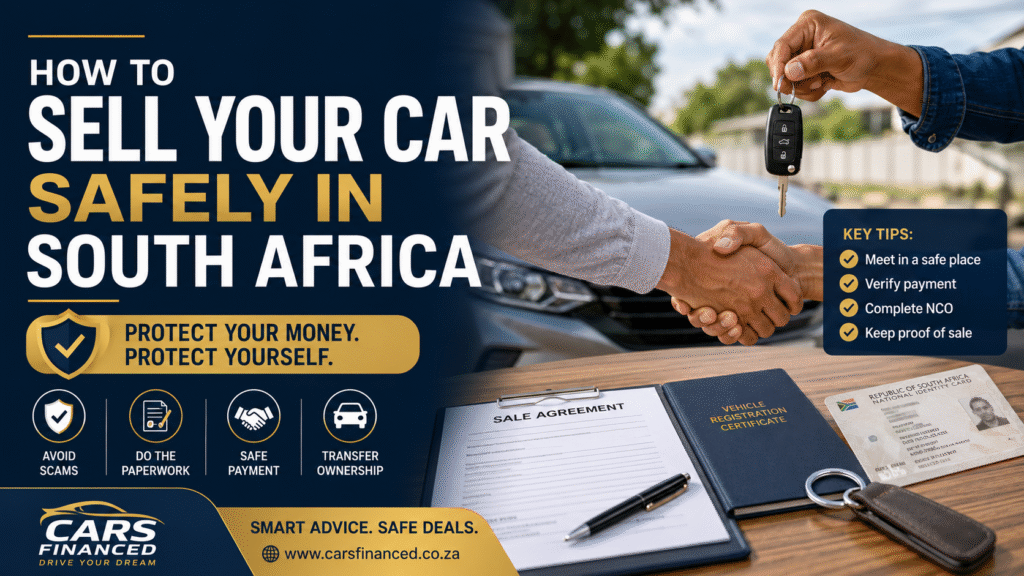
How to Sell Your Car Safely in South Africa
Sell car SA safely should be more than just a search phrase—it should be your priority whenever you decide to sell a vehicle privately. Selling a car can put a significant amount of money into your hands, but it can also expose you to scams, fraudulent payments, stolen vehicles, identity theft and ownership-transfer problems if you are not careful.
Whether you are upgrading to a newer vehicle, settling an existing finance agreement or simply want to get rid of a car you no longer need, the safest approach is to prepare properly before advertising it. You also need to verify the buyer, protect your personal information, confirm payment before handing over the vehicle and make sure the ownership change is properly recorded.
In this Cars Financed guide, we explain exactly how to sell car SA safely, from preparing your vehicle and creating an advert to handling payment, paperwork, test drives and the final change of ownership.
Why You Need to Be Careful When Selling a Car Privately
A private car sale can look straightforward. You advertise the vehicle, a buyer contacts you, you agree on a price, receive payment and hand over the keys.
In reality, there are several points where a seller can become vulnerable.
For example, criminals may use fake proof of payment, stolen identities, fraudulent banking transactions or false documents. A dishonest buyer may also attempt to pressure you into handing over the vehicle before the money has actually cleared.
Therefore, learning how to sell car SA safely means protecting yourself throughout the entire transaction—not just finding a buyer.
Step 1: Make Sure You Are Legally Able to Sell the Vehicle
Before advertising your car, confirm that you are the registered owner and that your vehicle documentation is in order.
The South African Government explains that when selling a used vehicle, the seller must notify the relevant registering authority of the change of ownership using the Notification of Change of Ownership (NCO) process. The government also states that the seller should provide the required registration documentation and that the vehicle registration process is recorded on eNaTIS. South African Government: Register a motor vehicle. :contentReference[oaicite:0]{index=0}
Check your registration certificate before you advertise the vehicle. Make sure your name and vehicle details are correct.
If the vehicle is still financed, things are different. The financial institution may be the registered title holder, meaning you cannot simply sell the vehicle as though it were completely paid off. Confirm the settlement process with your finance provider before accepting a buyer’s money.
Step 2: Check Whether Your Car Is Still Under Finance
If you still owe money on your vehicle, do not hide this from a prospective buyer.
Instead, contact your finance provider and request a settlement figure. This tells you approximately how much is required to settle the outstanding finance, subject to the lender’s terms and the validity period of the quotation.
You can then calculate whether the vehicle’s selling price will cover the outstanding finance.
For example:
- Agreed selling price: R180,000
- Outstanding finance: R150,000
- Potential amount remaining after settlement: R30,000
However, if the settlement figure is higher than the agreed selling price, you will need to understand how the shortfall will be settled before the transaction can be completed.
This is one reason why checking your finance position should be part of your sell car SA safely plan.
Step 3: Prepare Your Vehicle Before Advertising It
First impressions matter.
You do not necessarily need to spend thousands of rands preparing your car for sale. However, a clean, presentable vehicle is easier for potential buyers to assess.
Before taking photographs, consider:
- Washing and cleaning the exterior
- Vacuuming the interior
- Cleaning the windows
- Removing unnecessary personal belongings
- Checking tyre condition
- Checking that lights are working
- Gathering service records
- Finding spare keys
- Collecting relevant vehicle documentation
Be honest about the condition of the car. If there are scratches, dents, warning lights or mechanical problems, disclose them rather than trying to hide them.
Honesty can help you avoid disputes later.
Step 4: Take High-Quality Photos
Your photographs are often the first thing a potential buyer will see.
Take clear photographs during daylight and include several angles of the vehicle.
Your photographs can include:
- Front of the vehicle
- Rear of the vehicle
- Both sides
- Interior
- Dashboard
- Odometer
- Tyres
- Engine bay
- Boot
- Any visible damage
Do not photograph sensitive documents containing your full personal information and upload them publicly.
When you sell car SA safely, your advert should give buyers enough information to evaluate the vehicle without unnecessarily exposing your personal data.
Step 5: Write an Honest Car Advertisement
A good advert should provide enough information for a serious buyer to make an informed decision.
Include details such as:
- Make and model
- Year
- Variant or specification
- Current mileage
- Transmission
- Fuel type
- Service history
- Number of previous owners, where known
- Accident history, where applicable
- Known mechanical issues
- Licence status
- Asking price
Avoid exaggerated claims such as “perfect condition” if the vehicle has significant faults.
Instead, explain the vehicle accurately and let the buyer decide whether it suits them.
Step 6: Be Careful With Your Personal Information
One of the easiest mistakes sellers make is giving strangers too much information.
You do not need to publish your home address, ID number, banking password, PIN or other sensitive information in a vehicle advertisement.
When communicating with potential buyers, keep the conversation focused on the vehicle and transaction.
If someone asks for unnecessary personal information, becomes aggressive or pressures you to act immediately, consider it a warning sign.
Step 7: Verify the Buyer Before Meeting
Once somebody expresses serious interest, ask sensible questions.
You can ask:
- Are you buying for yourself?
- Have you seen the advert and vehicle details?
- Are you comfortable with the asking price?
- Will you be paying cash or using vehicle finance?
- When would you like to view the vehicle?
You should never feel pressured to accept a transaction simply because someone says they have the money available immediately.
If the buyer wants to use finance, the process should be handled through the relevant finance provider rather than relying on informal promises.
Step 8: Never Ignore Red Flags
Knowing the warning signs can help you sell car SA safely and avoid becoming the victim of a scam.
Be cautious if a potential buyer:
- Offers significantly more than your asking price
- Pressures you to hand over the vehicle immediately
- Sends suspicious proof of payment
- Refuses to meet in a safe location
- Wants to send a courier without a clear reason
- Asks you to refund an “overpayment”
- Asks for your banking login details
- Claims payment has been made when it is not showing in your account
- Uses an unusual or complicated payment arrangement
One of the most important rules is simple: never hand over the car based only on a screenshot or proof of payment.
Step 9: Meet the Buyer in a Safe Location
A stranger does not need to know where you live just because they want to inspect your car.
Whenever possible, arrange to meet in a busy, public location during daylight hours.
Consider locations such as:
- A busy shopping centre
- A reputable dealership or automotive environment
- A bank or financial institution, where appropriate
- A police-station area where permitted
- Another secure public location
Tell somebody you trust where you are going and who you are meeting.
Also, if a buyer wants to test-drive the vehicle, do not simply hand over the keys and allow them to drive away alone.
Step 10: Be Careful With Test Drives
Test drives are a normal part of selling a vehicle, but they should be controlled.
Before allowing someone to drive your car, check that they have an appropriate driver’s licence and remain with them during the test drive.
Choose a familiar route rather than allowing a stranger to take the vehicle somewhere unknown.
Do not leave the original vehicle documents, spare keys or other valuables inside the vehicle during the test drive.
If the buyer refuses reasonable safety precautions, you are under no obligation to continue with the viewing.
Step 11: Agree on the Price in Writing
Once you and the buyer agree on a price, document the agreement.
A written sales agreement should clearly identify:
- The seller
- The buyer
- The vehicle
- Vehicle identification details
- Agreed purchase price
- Payment method
- Date of sale
- Known defects or disclosed issues
- Any conditions attached to the transaction
Both parties should retain a copy.
A written agreement can help reduce misunderstandings and gives both sides a record of what was agreed.
Step 12: Verify the Money Before Handing Over the Vehicle
This is arguably one of the most important steps when you sell car SA safely.
Do not rely on a WhatsApp screenshot, email notification or SMS claiming that payment has been made.
Check your own bank account using your normal banking application or another trusted method.
The money must actually reflect as available according to your bank’s confirmation before you release the vehicle, keys or documents.
If the buyer claims there is a delay, do not allow pressure to change your decision.
There is no reason to hand over a vehicle before you have confirmed the payment yourself.
Step 13: Complete the Change of Ownership Correctly
Completing the ownership transfer is not something you should leave for later.
According to the South African Government, when selling a used vehicle, the seller must first complete and submit the Notification of Change of Ownership (NCO) form. The buyer then needs to register the vehicle in their name. The government states that the registration process must take place within 21 days after the change of ownership. View the official South African Government vehicle registration requirements. :contentReference[oaicite:1]{index=1}
Importantly, do not assume that the buyer will automatically take care of everything.
Make sure you complete your part of the process and retain evidence that you notified the relevant registering authority.
Some municipal guidance specifically advises sellers to submit the NCO in person because the vehicle can remain the seller’s responsibility until the registering authority has been notified. :contentReference[oaicite:2]{index=2}
What Is the NCO Form?
The NCO stands for Notification of Change of Ownership.
It is used to notify the relevant registering authority that ownership of the vehicle has changed.
The official NCO documentation states that the seller must complete the relevant sections and submit the notification to the appropriate registering authority within 21 days of the sale. :contentReference[oaicite:3]{index=3}
Keep copies of the completed documents and any proof of submission for your records.
What Documents Should You Prepare?
Depending on the circumstances of the vehicle and the requirements of your registering authority, you may need documentation such as:
- Your identification document
- The vehicle registration certificate
- Completed NCO documentation
- Proof of purchase or written sale agreement
- Valid licence documentation
- Roadworthy documentation where required
- Finance settlement documentation, if applicable
The exact requirements can vary depending on the transaction and registering authority, so check the current requirements before attending the licensing office.
Step 14: Keep Proof That the Vehicle Was Sold
After completing the sale, create a file containing everything related to the transaction.
Keep:
- The signed sale agreement
- Copies of relevant identification documents where legitimately required
- Proof of payment
- Copies of NCO documentation
- Proof of notification to the registering authority
- Copies of correspondence with the buyer
- Finance settlement documents, if applicable
- Photos of the vehicle at the time of sale
Digital copies stored securely can be useful, particularly if you later need to demonstrate when the vehicle was sold.
Step 15: Cancel or Update Your Insurance
Once the vehicle has been sold and the transaction is complete, contact your insurer.
Tell them that the vehicle has been sold and ask what documentation they require to remove it from your policy or update your cover.
Do not simply assume the insurance will automatically be cancelled because the buyer has taken possession.
Step 16: Remove Your Personal Information From the Vehicle
Modern cars can contain a surprising amount of personal information.
Before handing over the vehicle, check for:
- Saved phone contacts
- Bluetooth connections
- Navigation history
- Saved home addresses
- Garage-door information
- Vehicle app accounts
- USB devices
- Personal documents
- Parking cards and access tags
Reset the infotainment system where appropriate and remove your personal accounts.
This is an easy step to overlook, yet it is an important part of protecting your privacy.
How to Sell Your Car Safely if the Buyer Uses Finance
Some buyers will not have the full purchase price available in cash. Instead, they may apply for vehicle finance.
In that situation, the transaction can involve additional documentation and coordination between the buyer, seller, finance provider and sometimes a dealership or intermediary.
Do not release the vehicle simply because the buyer tells you that their finance application has been approved.
Approval is not necessarily the same thing as funds being available to you.
Confirm the payment and settlement process with the relevant financial institution before releasing the vehicle.
What If You Want to Trade Your Car Instead?
Private selling is not the only option.
You could also consider trading the vehicle in when purchasing another car. A trade-in can be more convenient because the dealership handles much of the process, although you should still understand the value being offered for your current vehicle.
If you are thinking about replacing your vehicle, you may also find our Smart Path to Car Ownership guide useful when planning your next purchase.
Private Sale vs Selling Through a Professional
| Factor | Private Sale | Professional/Dealer Sale |
|---|---|---|
| Potential selling price | May be higher | May be lower |
| Convenience | More work for the seller | Usually more convenient |
| Buyer communication | Handled by seller | Usually handled by professional |
| Test drives | Seller manages them | Professional manages them |
| Payment arrangements | Seller must verify carefully | Usually managed through the business process |
| Paperwork | Seller must understand the process | Professional assistance may be available |
There is no single best option for everyone. The right choice depends on how much time you have, the value of the vehicle, your desired selling price and how comfortable you are managing the transaction yourself.
Sell Car SA Safely: The Seller’s Final Checklist
Before you hand over the keys, work through this checklist:
- Confirm you are the registered owner.
- Check whether the vehicle has outstanding finance.
- Obtain a settlement figure if applicable.
- Clean and photograph the vehicle.
- Advertise the vehicle honestly.
- Protect your personal information.
- Screen potential buyers.
- Meet in a safe public location.
- Check the buyer’s driver’s licence before a test drive.
- Keep control of the vehicle during the test drive.
- Agree on the price in writing.
- Confirm payment directly through your bank.
- Never accept a screenshot as proof of payment.
- Complete the required NCO documentation.
- Notify the registering authority as required.
- Give the buyer the required vehicle documents.
- Keep copies of all sale records.
- Notify your insurer.
- Remove personal information from the vehicle.
Frequently Asked Questions About Selling a Car in South Africa
What is the safest way to sell a car privately in South Africa?
The safest approach is to verify the buyer, meet in a secure public location, document the agreement, confirm that payment has actually cleared, and complete the ownership-transfer process correctly.
Can I sell a car that is still financed?
You may be able to sell a financed vehicle, but you need to involve the finance provider and settle the outstanding finance according to the lender’s requirements. Do not treat a financed vehicle as though it is unencumbered.
Should I give the buyer the car before payment clears?
No. Confirm the funds in your own bank account before handing over the vehicle, keys or other important documents.
Does the seller have to complete an NCO form?
Yes. The seller must notify the relevant registering authority of the change of ownership using the applicable NCO process. The South African Government states that this notification forms part of the process for transferring a used vehicle. :contentReference[oaicite:4]{index=4}
How long does the buyer have to register the vehicle?
The South African Government states that a vehicle should be registered and licensed within 21 days after a change of ownership. :contentReference[oaicite:5]{index=5}
Can I let the buyer test-drive my car alone?
It is safer to remain with the buyer during the test drive and to verify that they have the appropriate driver’s licence. Do not allow an unknown person to simply drive away with your vehicle.
Should I meet a buyer at my home?
It is generally safer to meet prospective buyers in a busy public location rather than giving strangers your home address. If you do need to show the vehicle at home, consider having another person with you.
What should I do if a buyer sends fake proof of payment?
Do not release the vehicle. Check your own bank account using your normal banking method. If the funds are not confirmed, treat the payment as uncompleted.
How can I sell car SA safely without getting scammed?
To sell car SA safely, take your time, verify the buyer, protect your personal information, never trust screenshots as payment confirmation, document the transaction and complete the official ownership-transfer process.
Final Thoughts: Sell Your Car With Confidence
Selling a vehicle should be a straightforward transaction, but rushing the process can create unnecessary risks.
Take the time to prepare your vehicle, advertise honestly, protect your personal information and verify every important part of the transaction.
Most importantly, remember that receiving a message saying “payment made” is not the same as receiving cleared funds. Always verify the money yourself before handing over the vehicle.
Finally, complete the official change-of-ownership process and keep your records. The South African Government confirms that sellers need to notify the relevant registering authority and that the ownership change is recorded through the vehicle registration system. :contentReference[oaicite:6]{index=6}
If you are selling your current vehicle because you want to purchase another one, Cars Financed can help you explore your next vehicle options.
Ready for your next car? Visit Cars Financed to learn more about vehicle finance and car-buying options in South Africa.
Disclaimer: This article is intended for general educational purposes and does not constitute legal, financial or insurance advice. Vehicle registration requirements and procedures can change, and sellers should confirm current requirements with the relevant registering authority before completing a transaction.